
300 Million Loads: The Compounding Edge You Can't Vibe-Code
LeadCapture's forms, quizzes, and pages have loaded over 300 million times, and we're on track for a billion by next year. A founder's take on why that compounding data advantage is the one thing you can't vibe-code together, and exactly how we build.
I pulled some data recently that stopped me in my tracks.
LeadCapture's quizzes, forms, and pages have now loaded over 300 million times.
And the honest truth is the real number is much higher. I don't even have the first three years of data. That was back when we were scrappy and hadn't moved everything onto the right databases yet. Those loads happened. I just can't count them. So think of 300 million as the floor, not the ceiling.
I want to sit with what that number actually means, because "300 million loads" on its own is just a vanity metric. Then I want to get to the part that matters: why that number is one of the biggest reasons to build on LeadCapture instead of gluing your own thing together, and exactly how we build because of it.
300 million moments of intent
Every single one of those loads is a person at the exact moment of intent.
Someone requesting a quote. Opting in. Comparing insurance rates, pricing solar, booking a consult, filling out the thing that turns an anonymous visitor into a real, reachable lead.
Three hundred million of those moments. Each one loading in under 200 milliseconds, on the first try, mostly on a phone.
That's not traffic. That's not pageviews. That's 300 million times someone was one step away from becoming a lead, and our platform was the thing standing in that gap.
From 300 million to a billion
It took us years to get to 300 million.
By this time next year, we'll cross one billion.
That's not a hopeful projection. That's the current trajectory. That's how fast this is accelerating... and the acceleration itself is the point. The curve is bending up, not flattening out.
But volume isn't the story. What's happening underneath that volume is the story.
The question I get asked all the time
Every so often someone asks me some version of this:
"Why should I use LeadCapture? Why not just vibe-code my own lead funnel with a few AI tools, test it, and maybe switch over later? Or honestly, why use anything at all?"
It's a fair question. The tooling to slap something together over a weekend has never been more accessible. Grab an AI builder, describe a form, wire up a Zapier zap, ship it.
And look, set aside all the deeply technical reasons this falls apart at scale. Page speed, deliverability, server-side lead delivery, tracking, CAPI, compliance in regulated verticals, YOUR TIME. That's a whole other post, and I'm always happy to get into it.
There's one reason that matters more than all of those combined, and it's the one nobody thinks about until it's too late.
Everything compounds inside LeadCapture
Every impression. Every interaction. Every completion and every drop-off. It all lives inside the platform.
Let me be crystal clear about what that does not mean, because this part matters: we do not share your funnels, your leads, or what's working for you. Not with anyone. Not without your explicit permission. Ever. Your campaigns are yours, full stop.
But at the aggregate level, across hundreds of millions of real interactions, we learn. We see what converts and what quietly kills a form. We see what a high-intent lead looks like three steps before they finish. We see which field, on which step, in which vertical, is costing people leads. And we take those lessons and build them straight back into the product and into the AI.
That's the part the "just vibe-code it" crowd misses entirely.
A tool you glued together last weekend knows nothing. It has no memory, no pattern, no prior. Every visitor is a first guess. LeadCapture shows up to your funnel already carrying 300 million loads' worth of hard-won lessons, before you even hit publish. That's why our customers see things like a 34% average lift in conversion. That number isn't magic. It's accumulated learning doing its job.
You cannot bolt that on. It only exists because of scale and time.
The flywheel
Here's the thing that makes it compound. It's not a straight line. It's a loop. Usage feeds data, data sharpens the product, a sharper product drives more usage. And three inputs pour into that loop from the outside.
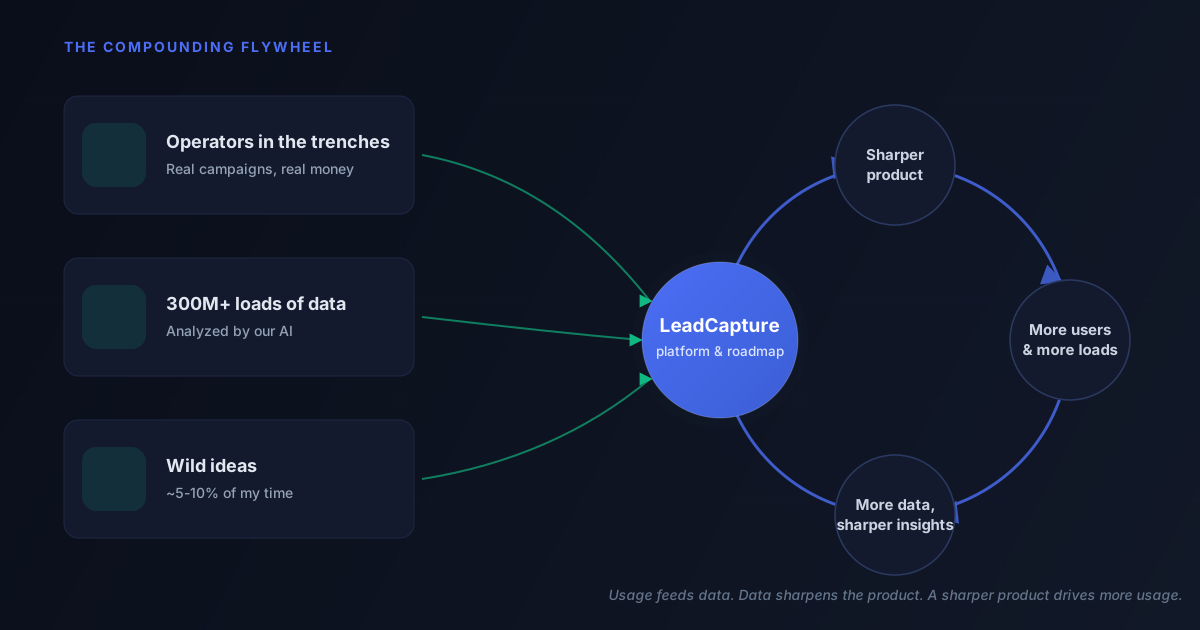
Every new customer makes the loop spin a little faster. Every load adds to the data. Every insight makes the product sharper, which brings in more customers. A weekend-built tool has none of this... it's a snapshot frozen the day you shipped it. LeadCapture is a flywheel that's been spinning for years and is only picking up speed.
How we build
So where does the roadmap actually come from? Three inputs. That's the whole recipe, and I'm deliberate about it.
1. The operators in the trenches
The single biggest source of what we build is people running real campaigns with real money on the line. Not focus groups. Not surveys. Not a product committee guessing at what users might want. Operators who hit a wall on a Tuesday afternoon and tell us exactly what they need to get unstuck.
The closer someone is to money on the line, the better their signal. When an agency is burning ad spend on out-of-area leads and asks for ZIP-based qualification, that's not a feature request, that's the market telling us where the pain is. When contact rates slip and people ask for tighter phone and email verification, that's the trenches handing us the roadmap. We ship those things because the people paying for outcomes told us they mattered.
Most of what LeadCapture does well, it does well because an operator needed it first.
2. The data
Then there's the data. Years of it. Three hundred million loads and counting, analyzed and pattern-matched until it tells us something we didn't already know.
The data doesn't have opinions or an agenda. It doesn't care what's trendy. It just shows us the truth about what works, which step loses people, which field kills a conversion, what a high-intent lead looks like before they finish. Our AI reads those patterns across the whole platform and we build around what it finds.
And to say it again, because it's important: we learn at the aggregate level, and we never touch an individual customer's funnels or leads without their permission. The lessons are patterns, not people's campaigns. Those patterns are what make the AI smarter for the next person who builds a funnel, including the person who just signed up an hour ago and gets to stand on years of accumulated learning on day one.
3. The wild ideas
And then there's the last slice, maybe 5 to 10% of my time, spent throwing out crazy ideas nobody else is thinking about.
Every product needs some swings that aren't derived from data or from a request. Bets on where things are going, not where they are. The data can only tell you about the world that already exists. The trenches can only tell you about problems people can already name. Somebody has to make the leap to the thing nobody asked for because nobody knew to ask. That's my job as the founder, and I protect that time on purpose.
Some of those swings miss. The ones that land are usually the features people later can't imagine working without.
Those are the only three inputs. The trenches, the data, and the occasional swing. Notice what's missing from that list?
Why I never look at the competition
I never look at the competition. I mean it. I don't watch what other tools are shipping, I don't read their changelogs, I genuinely don't think about them.
The moment you start building by reacting to competitors, you've handed them your roadmap. You're always one step behind, building last quarter's version of someone else's idea, and you've quietly outsourced your judgment to a company that doesn't know your customers.
I'd rather build from the ground truth: real operators, real data, real intent, hundreds of millions of times over, plus the occasional bet on where the world is heading. That's a better compass than any competitor's feature list will ever be.
That's the difference
A vibe-coded tool gives you a form. It works until it doesn't, and it never gets smarter.
LeadCapture gives you a capture layer that's been shaped by 300 million real moments of human intent... and gets sharper every single day, because every load feeds the loop that makes the next one convert better.
300 million down. A billion by this time next year.
That's a milestone. It's a flywheel. And it's the one thing you can't build over a weekend.
John Porrini is the founder of LeadCapture.io. He got his start in lead generation at 12 years old and has spent 20+ years in lead generation and performance marketing.
Ready to capture more leads?
Build and optimize high-converting lead funnels, quizzes, and forms with AI-powered lead capture software.
Start Free Trial