
Introducing LeadCapture Next Gen: Why We Rebuilt LeadCapture for the AI Era
LeadCapture Next Gen is a ground-up rebuild of our lead generation platform — featuring AI-powered funnel building, real-time lead verification and enrichment, and a unified builder designed for speed and simplicity.
Today I'm sharing the biggest announcement in LeadCapture history.
We've officially launched LeadCapture Next Gen, a brand-new platform rebuilt from the ground up. This post is my attempt to explain what it is, why we built it, and what you can expect as we keep shipping into the future.
I want this to feel founder-led and real, because the decision to rebuild wasn't a marketing move or a minor refresh. It was a line in the sand about what LeadCapture should become.
Before I get into Next Gen, I want to address the obvious question.
If you're already using LeadCapture, the platform you know is not going anywhere.
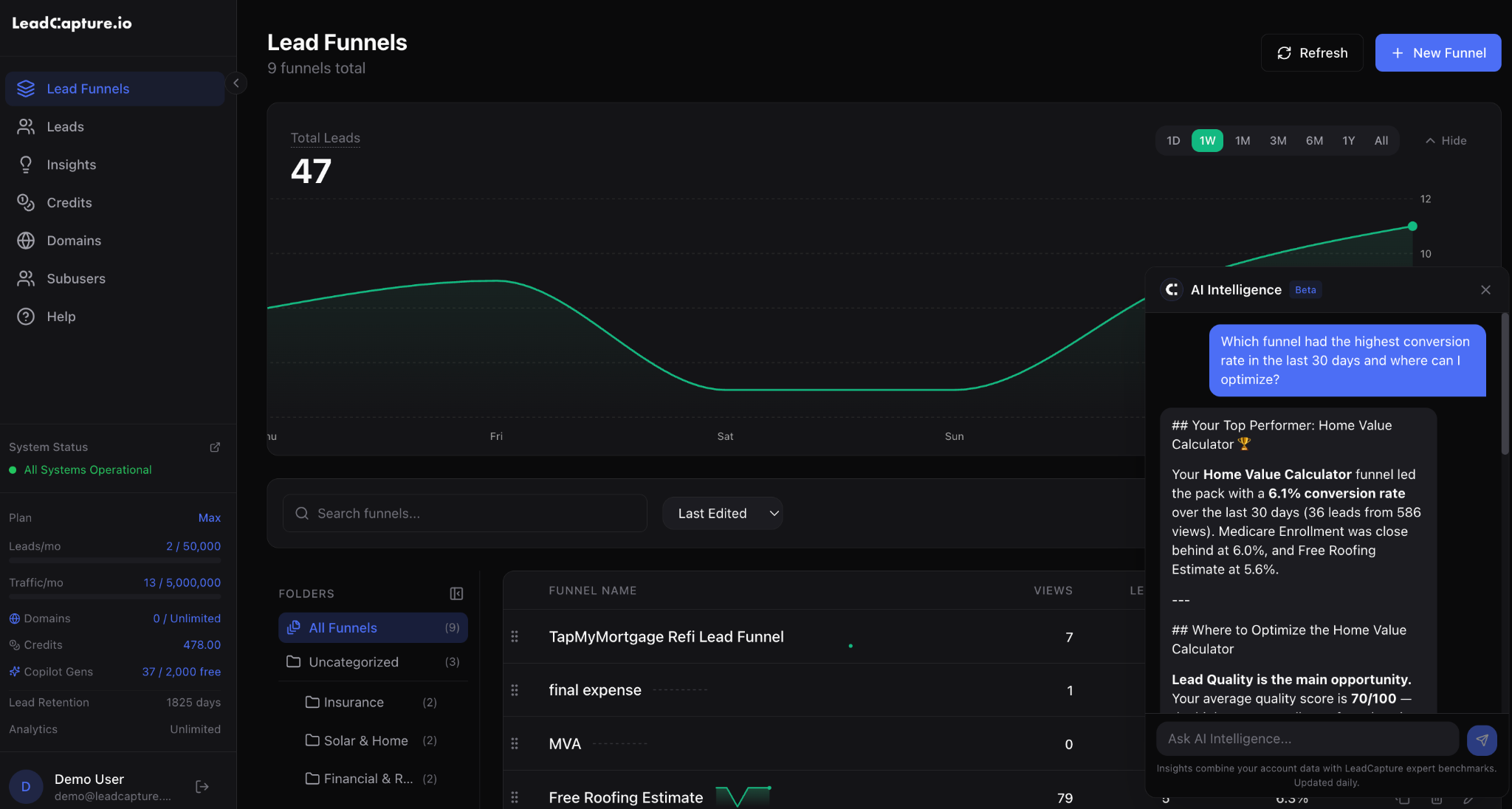
LeadCapture Classic is staying, and it matters
The current platform is now called LeadCapture Classic.
Classic will continue to exist. We're continuing to support it. We're continuing to keep it stable, high-performing, and reliable. We're continuing to fix bugs, make improvements where it makes sense, and keep it functioning at a high level.
This is not a forced migration situation. We're not flipping a switch and pushing everyone into a new product. Going forward, both platforms will run in parallel. You can pick the platform that matches how you work.
This post is focused on Next Gen because it's where the future is heading, but I want to say this clearly. If Classic is working for you, you're good.
Quick background on how we got here...
I started LeadCapture back in 2019 because I needed something that, honestly, didn't really exist the way I wanted it to.
At the time, I was a performance marketer and lead generator. I wanted a high-converting multi-step form that was flexible, customizable, and actually built for lead gen. Surprisingly, there weren't many tools that did that well, especially if you needed more control than the typical "form builder" platforms gave you.
So I built it.
The early version of LeadCapture was almost laughably simple. There was no backend UI. There was no admin dashboard. There were no advanced features. I was building forms in JSON, uploading them to a server, and capturing leads. That was it.
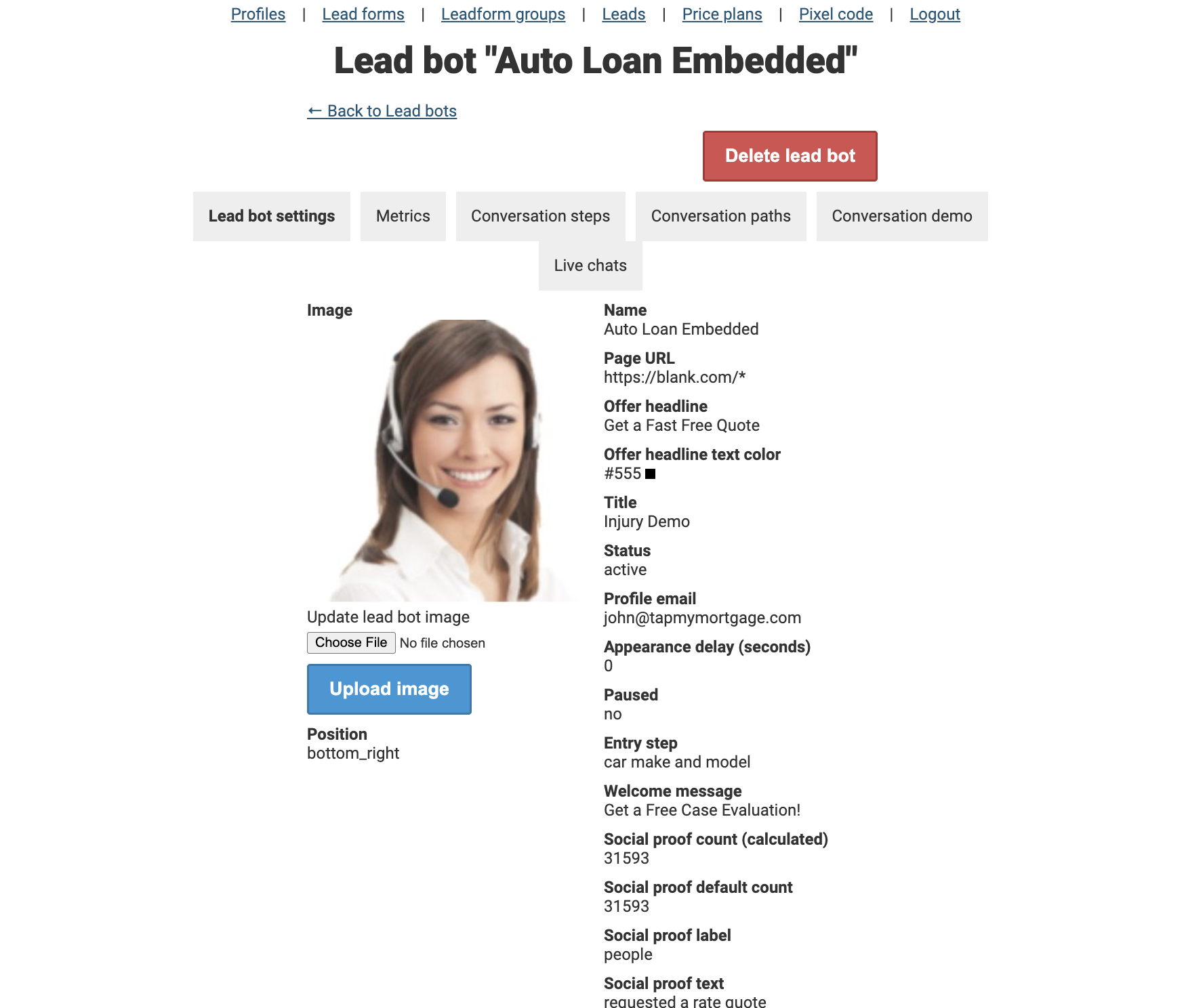
Our very first UI!!
But the forms converted. They converted really well.
Then people started asking to use them. Then those people asked for features. Then more people showed up. And over time, LeadCapture evolved into a full platform because it needed to.
The trade-off of moving fast: technical debt
If you've ever built software, you already know what happens next.
We moved extremely fast for years. We shipped features quickly. We listened to customers. We solved problems as they showed up. We stuffed features in. We made it work. We stayed close to real lead gen use cases, and we shipped what helped people capture leads.
That speed is part of what made LeadCapture what it is.
But it also created the downside that every fast-moving software company eventually runs into. Technical debt piles up. Architecture decisions made years ago start to limit what you can do now. The platform becomes harder to reshape. The cost of adding new capabilities increases, not because the ideas are hard, but because the foundation wasn't designed for where the world is going.
Heading into 2026, that tension started to really come to surface.
POV: The world changed, and lead gen changed with it
Over the last few years, the tech world shifted in a way that's hard to ignore.
AI stopped being a "cool thing some companies are testing" and started becoming part of everything. Cloud tools got better. New architectures emerged that made SaaS products more efficient to build, run, and manage. At the same time, expectations in lead gen rose.
People don't just want to capture leads anymore. They want to capture better leads. They want fewer junk submissions. They want verification at the point of capture. They want enrichment without asking 25 questions. They want speed. They want workflows that are simple enough to run without a full-time operator.
And personally, I couldn't stop thinking about a bigger question.
How do we take advantage of AI in lead generation in a way that actually matters?
Not just internally to help us build faster, but externally so our users can build funnels more efficiently, optimize them more intelligently, and improve lead quality without turning everything into a complex project.
This idea sat in the back of my mind while feature requests kept stacking up.
Landing pages. More enrichment. Better usability. More automation. Faster iteration. AI-assisted building. AI-assisted editing. Better insights. And a platform that could support all of it.
That's when I realized we had two paths.
We could keep doing incremental updates to Classic, taking the slower methodical approach that works fine when you're evolving within the constraints of the current product.
Or we could take a much bigger step. The kind of step that's uncomfortable. The kind of step where you put a lot on the line. The kind of step where you decide to build the LeadCapture that will last, not for the next year, but for the next decade.
We chose the second path.
Stepping outside of the box... the moment everything converged
I remember waking up one morning and it hit me.
There were too many things we needed to do, and too many of them were pointing toward the same conclusion. I'd been promising a landing page builder for a long time (and hated the version we almost shipped). I'd been wanting to do more with AI to make funnel building faster and easier. I'd been wanting to expand enrichment so lead quality could improve without adding friction. I wanted the platform to be easier to use without needing assistance. I wanted LeadCapture to feel modern again from the inside out.
So we paused. I stepped outside the box of "what LeadCapture is right now" and started thinking about "what LeadCapture should be tomorrow."
And then something happened that I didn't expect. Over the course of a few days, everything started snapping into place. The feature requests, the vision, the tech decisions, the pillars we cared about, the way AI could weave through it all.
That convergence became Next Gen.
I call it Next Gen for a reason. It is not meant to be a slightly improved version of today. It's meant to be the next version of LeadCapture, built for where this is going.
What Next Gen is, in plain English
LeadCapture Next Gen is the next generation of our platform, rebuilt from scratch to help you succeed in three core areas.
-
First, capturing more leads using high-converting lead funnels that keep conversion rates high and cost per lead low.
-
Second, improving lead quality with verification and enrichment at the point of capture.
-
Third, maximizing workflow efficiency so you can move faster, get more done, and spend less time in the weeds.
Next Gen still supports the same fundamental job LeadCapture has always done. It helps you create lead funnels and forms that convert.
But the difference is the foundation, the workflow, and the role AI plays in the product.
In Next Gen, AI is not a bolted-on feature. It's part of how you build. It's part of how you edit. It's part of how you write. It's part of how you optimize.
What you'll notice first: the platform view that orients you fast
When you sign into Next Gen, the first thing you see is a high-level performance view that aggregates metrics across all funnels. It's meant to orient you quickly.
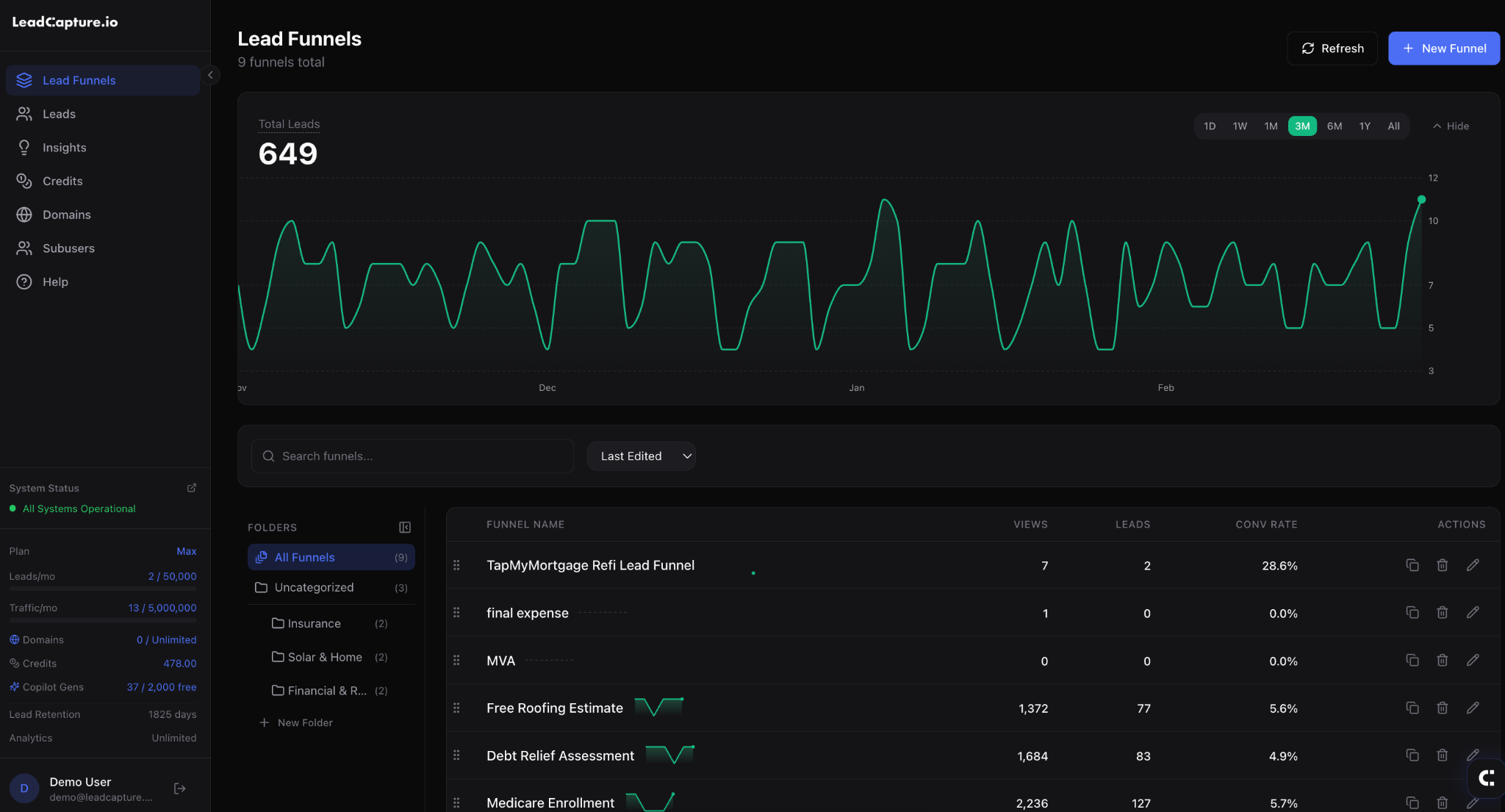
You can zoom in by day, week, month. You can search by funnel. You can scan funnel performance using spike charts that show leads and conversion trends. You can organize funnels into folders so an account doesn't turn into chaos.
If you want to drill deeper, you click into a specific funnel and get the funnel-level view, including conversion trends and step-by-step drop-off so you can see where people fall off and where the friction is.
This is intentional. A lot of platforms make you work too hard to understand what's happening. Next Gen is designed so you can answer basic questions quickly before you even start optimizing.
And if you want deeper answers fast, AI Intelligence is always there in the corner, ready to analyze and explain what's going on without you having to dig through a maze of reports.
Next Gen is built around a unified funnel builder
One of the biggest shifts in Next Gen is the way we think about funnels.
For years, lead gen teams have been forced into a weird workflow. Landing page in one platform. Form in another. Analytics scattered. Speed inconsistent. Updates are annoying. The "funnel" lives across multiple tools.
In Next Gen, you can build a unified lead funnel where the landing page and the multi-step quiz live together in the same flow.
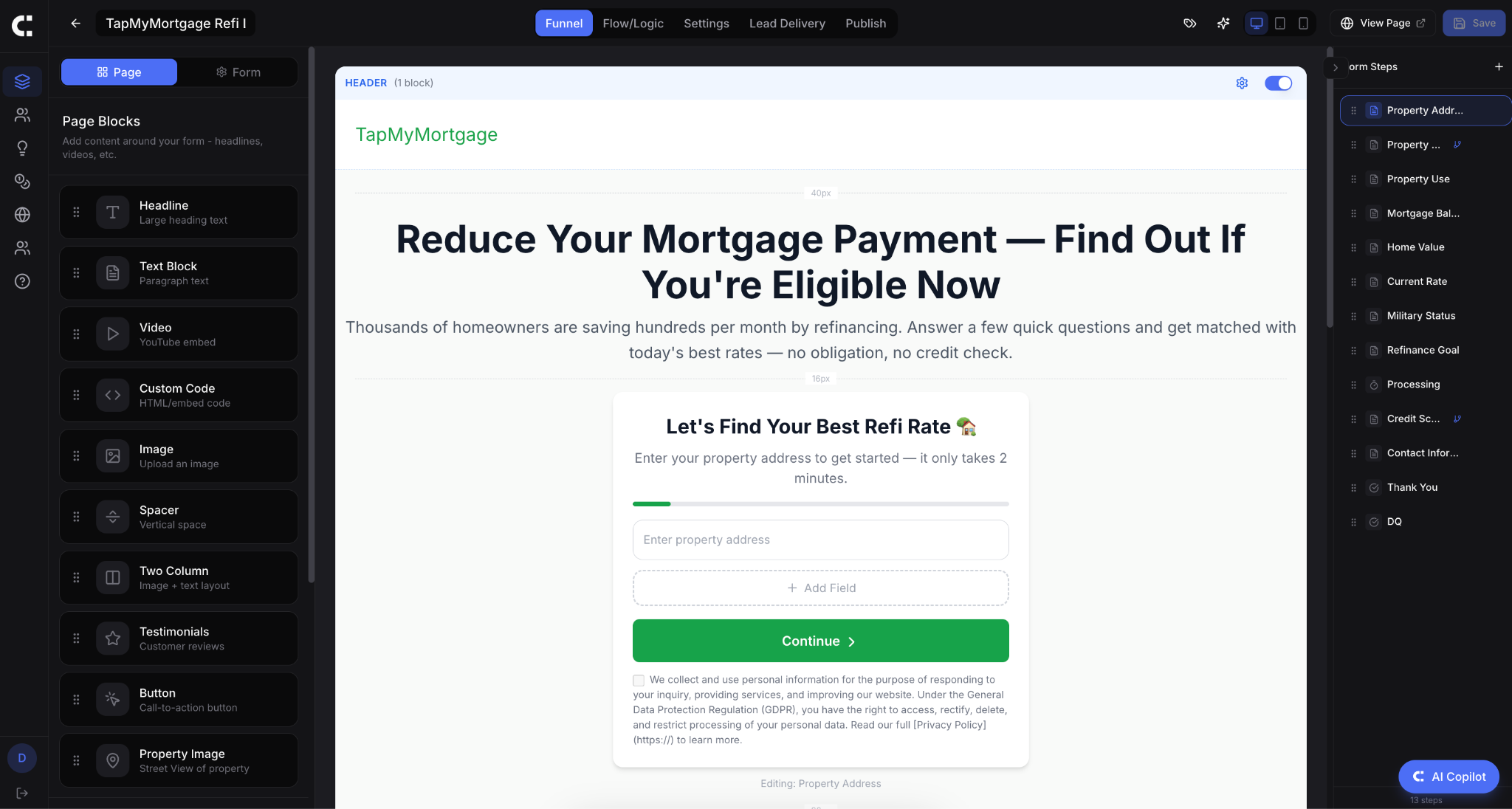
You can still embed just the quiz anywhere, and that flexibility is never going away. But by default, Next Gen gives you the ability to create a complete mobile-first funnel, connect your own domain, and run everything as a single fast experience.
This matters because the marketers winning today are not stitching together slow pages and generic forms. They're building mobile-native lead funnels that load fast and are designed to guide someone step by step.
That's what we're building around.
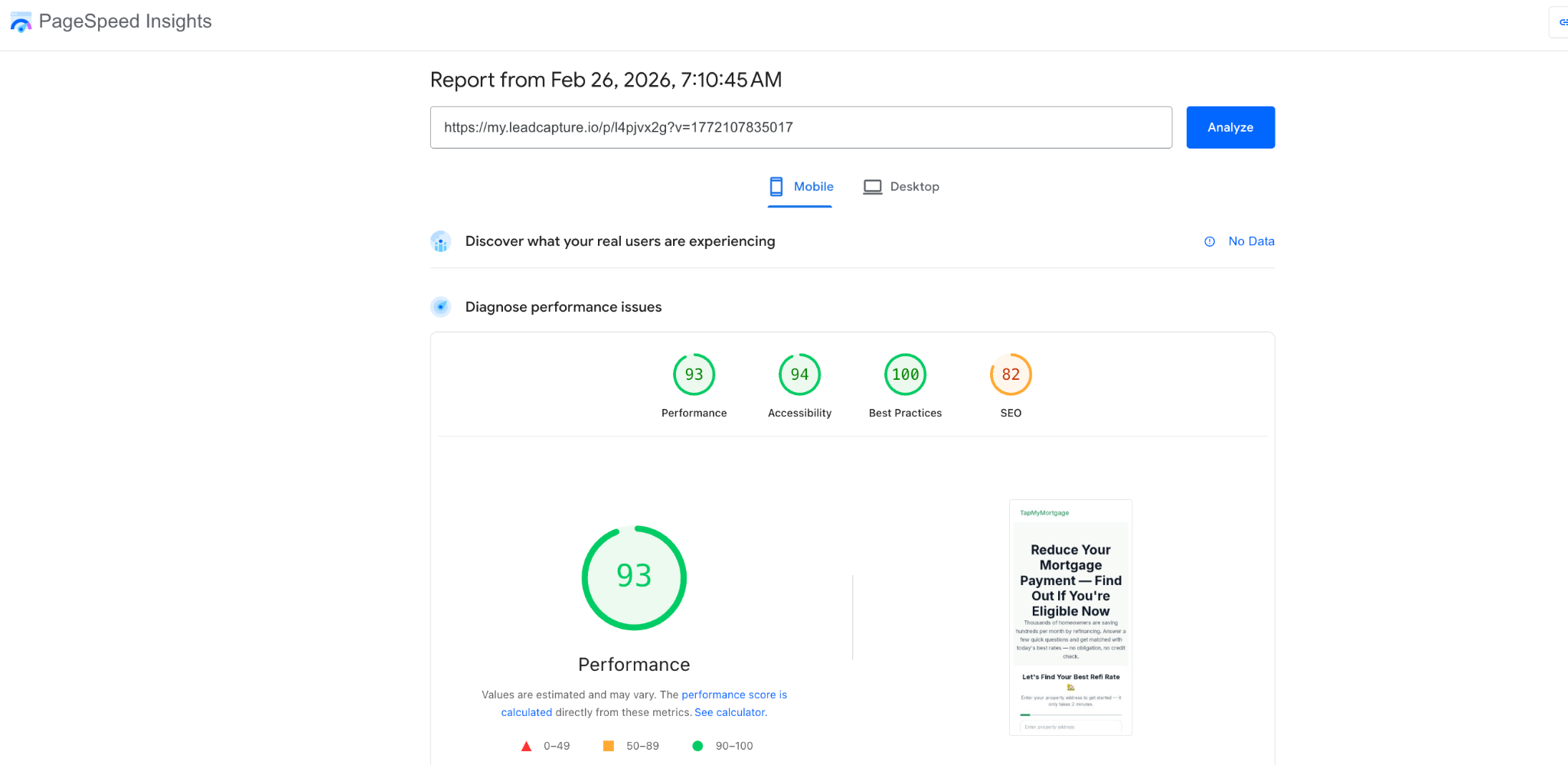
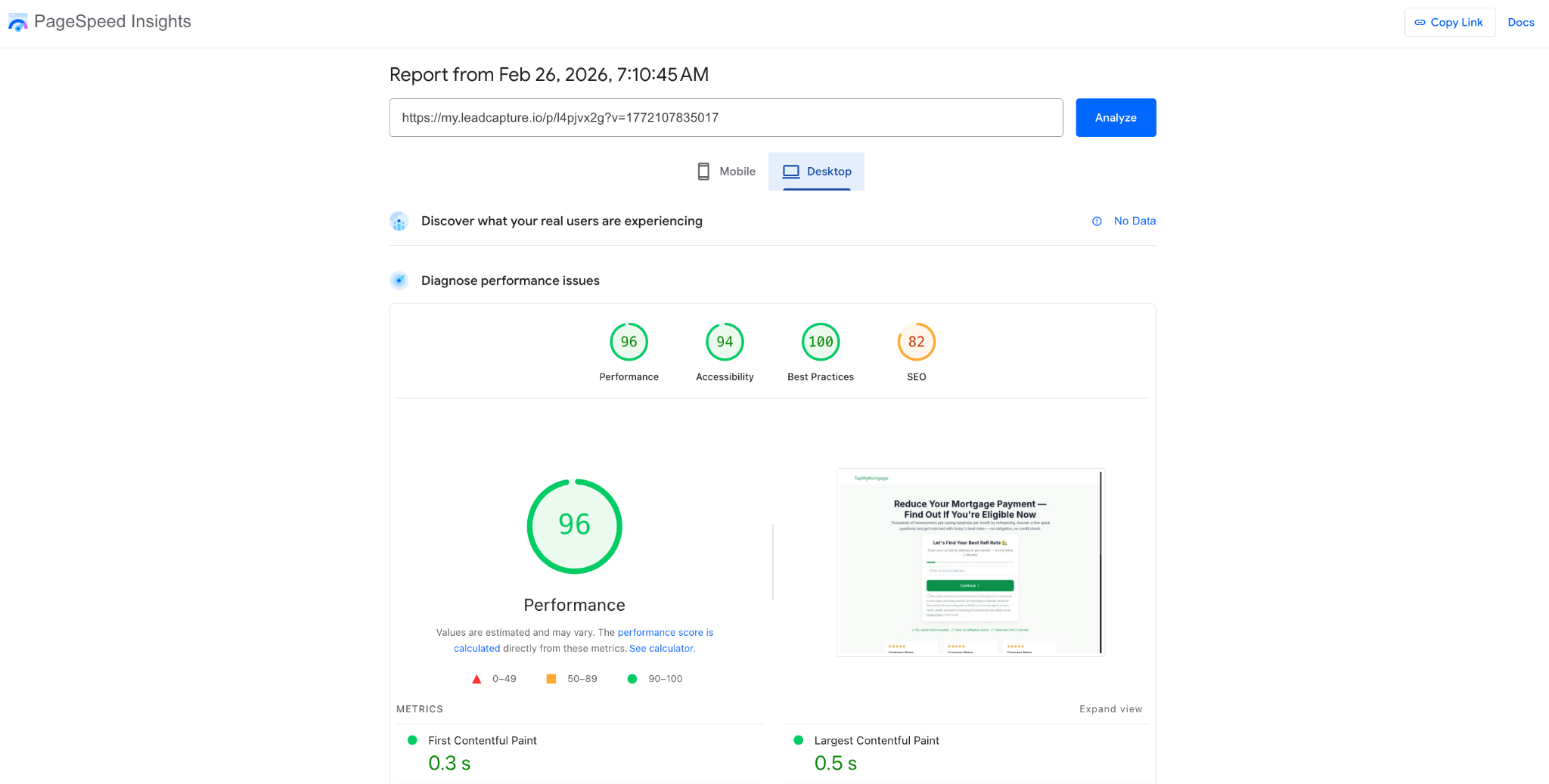
Load speed is not a nice-to-have
I'm obsessed with funnel speed because it affects conversion. Slow funnels cost you money.
In Next Gen, we architected funnels with performance in mind. The goal is simple. Build lead funnels and forms that load fast and stay fast.
On mobile:
On desktop:
This is also why we tightened up the tech stack. Less clunky tooling. More streamlined architecture. Fewer moving parts. More stability. Faster iteration.
When a platform is simpler under the hood, it becomes easier to make it faster for users and easier for us to ship improvements without breaking things.
A builder that feels like building, not steering a ship
Another big focus in Next Gen is usability.
Building a lead funnel should not feel like you're trying to steer a ship. It should feel straightforward. You should be able to move quickly without needing someone to "set it up for you."
Next Gen includes a re-architected funnel builder that makes it easier to build, adjust, and manage a funnel without friction. You can drag blocks into the page. You can edit steps and fields cleanly. You can reorder steps by dragging. You can add transition steps like "Analyzing your results" to improve completion rates and create a more polished experience.
Those little things add up.
Lead quality is a pillar, with more data enrichment and verification features
Conversion rate is only half the game.
If the leads are junk, the funnel isn't actually winning. Your sales team suffers. Your clients suffer. Your buyers complain. And the whole system breaks down.
Next Gen is designed to give you more lead quality intelligence at the point of capture, and to give you tools that you can turn on as needed.
In Next Gen, a lead record is not meant to be a full CRM. It's meant to capture the responses, the context, and the intelligence that matters, then pass it into your CRM or lead distribution tool.
That includes practical things like user agent, IP address, and logging, which help you diagnose spam patterns and troubleshoot delivery issues.
It also includes enrichment data designed specifically for lead gen decisions.
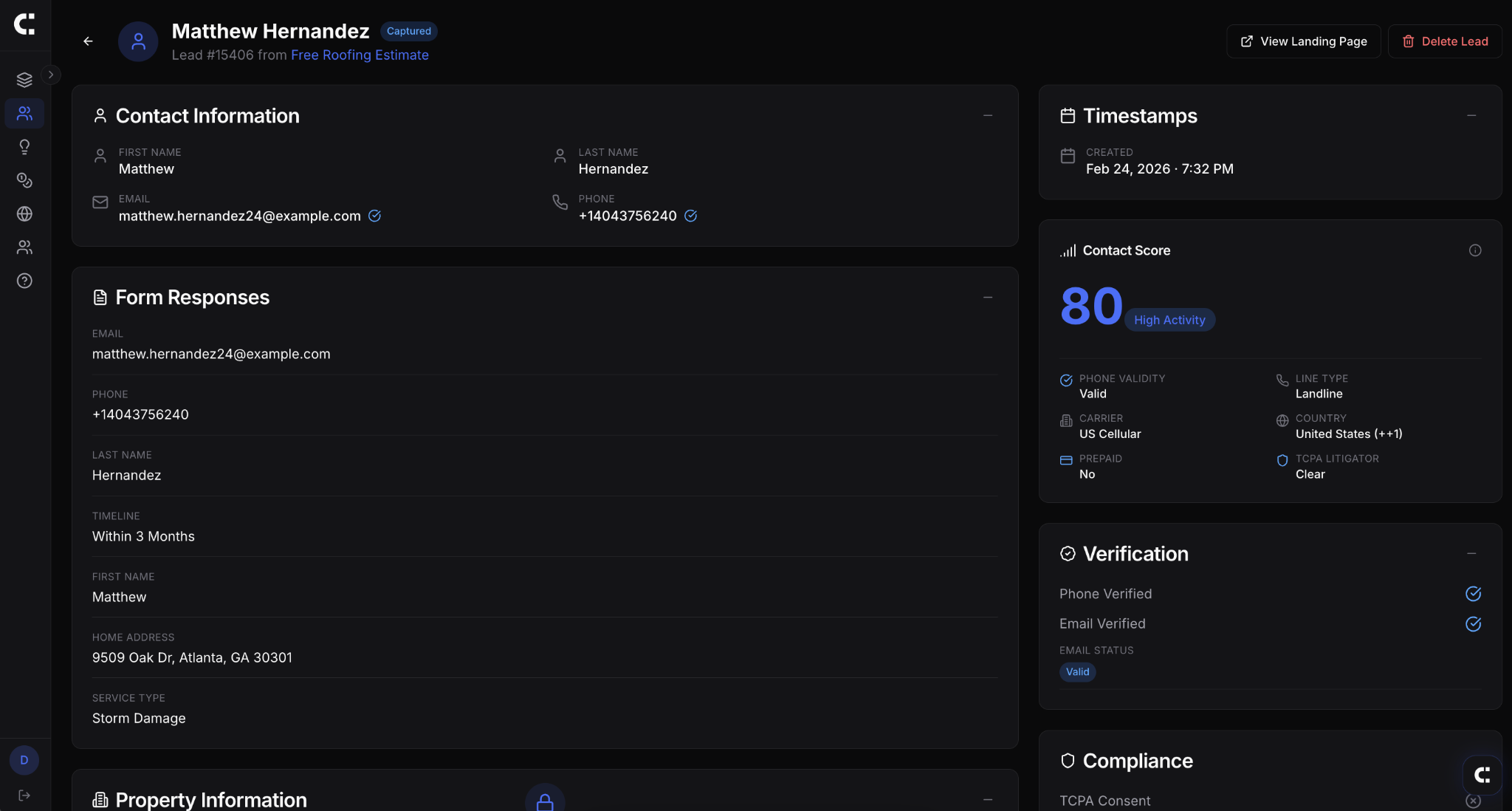
Contact Score and phone intelligence
One of the most unique Next Gen features is Contact Score and phone number enrichment.
It's a 0 to 100 score that estimates how likely someone is to pick up the phone. It's paired with phone intelligence data like carrier, line type, prepaid status, validity, and TCPA litigator risk.
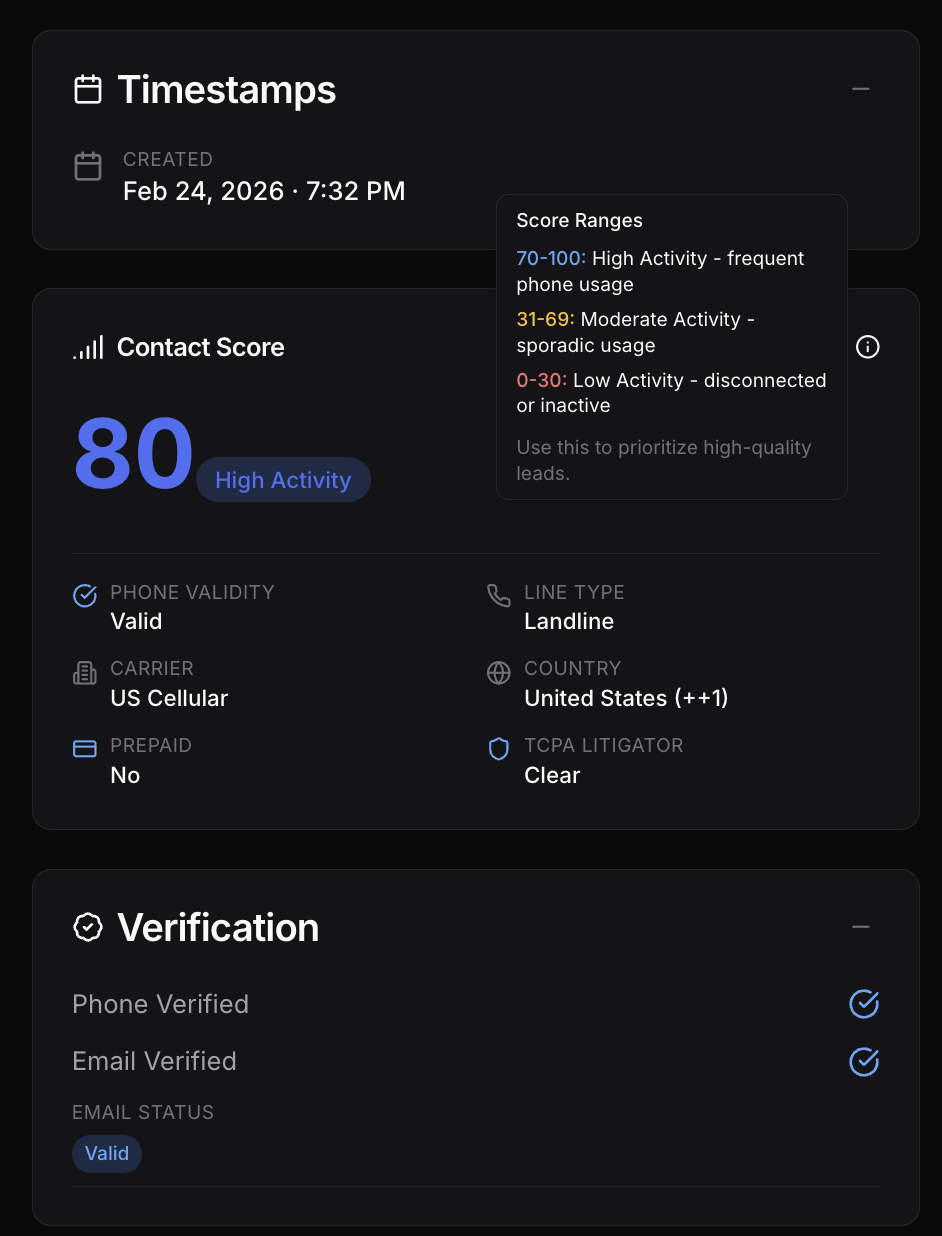
This matters because you can now make decisions at the point of capture.
You can pass the data downstream into your CRM or distribution system.
Or you can block leads that don't meet your rules. For example, blocking invalid numbers, blocking low contact scores, blocking prepaid, blocking TCPA litigator risk.
The point is not that everyone should block aggressively.
The point is that you now have the option to protect lead quality without adding friction to the funnel.
Real estate enrichment and skip tracing
If you operate in industries like real estate, mortgage, or home services, Next Gen takes enrichment further.
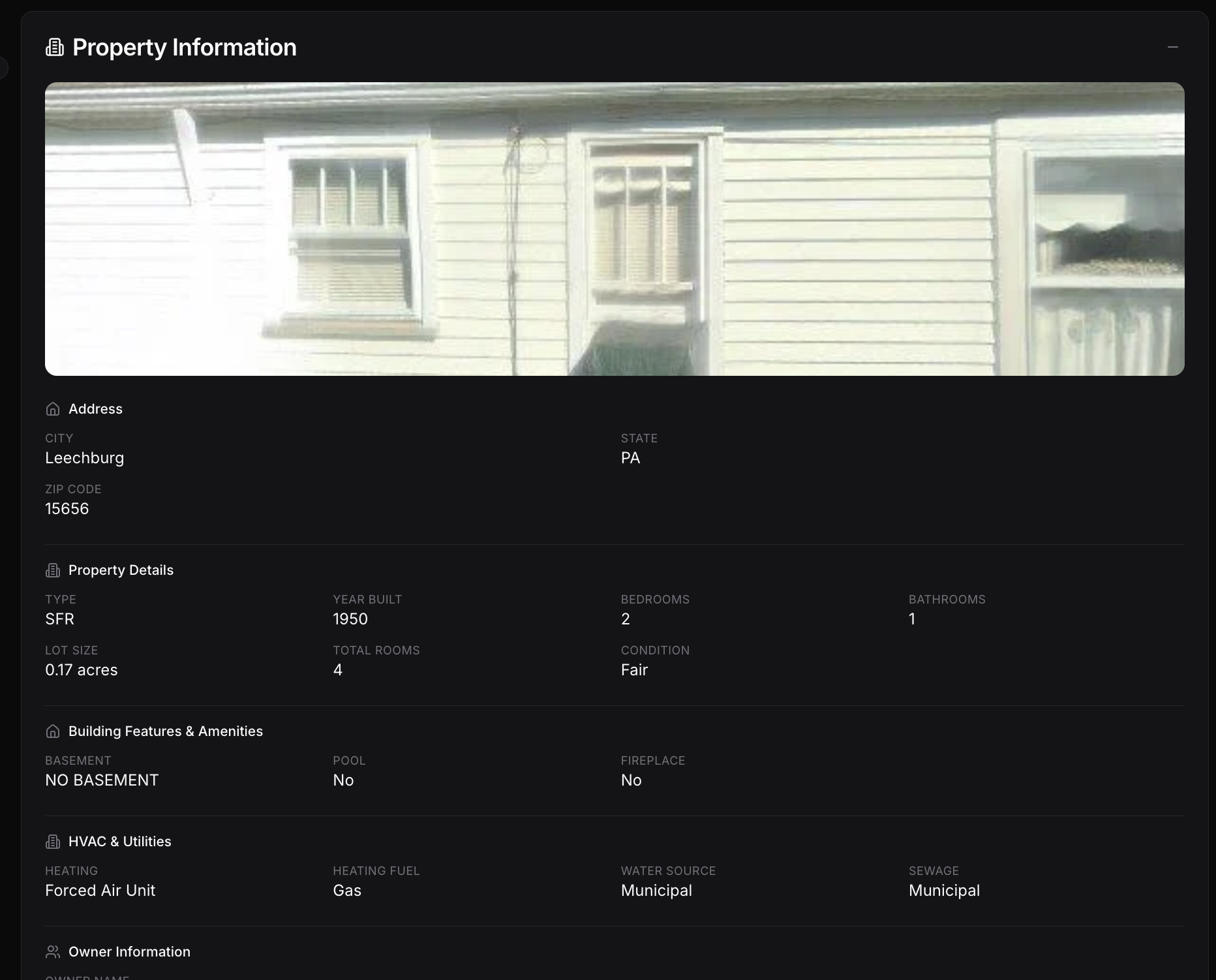
You can enrich leads with property data and pull in dozens of data points without asking extra questions in the funnel. This improves conversion because you can ask less while getting more.
And for teams that need it, Next Gen also brings skip tracing directly into the platform so enrichment and downstream workflow can be tighter.
AI is built into Next Gen in three practical ways
AI can get overhyped fast. I'm not interested in adding AI just to say we have AI.
In Next Gen, we focused on AI in areas where it directly improves how you work. And how you optimize.
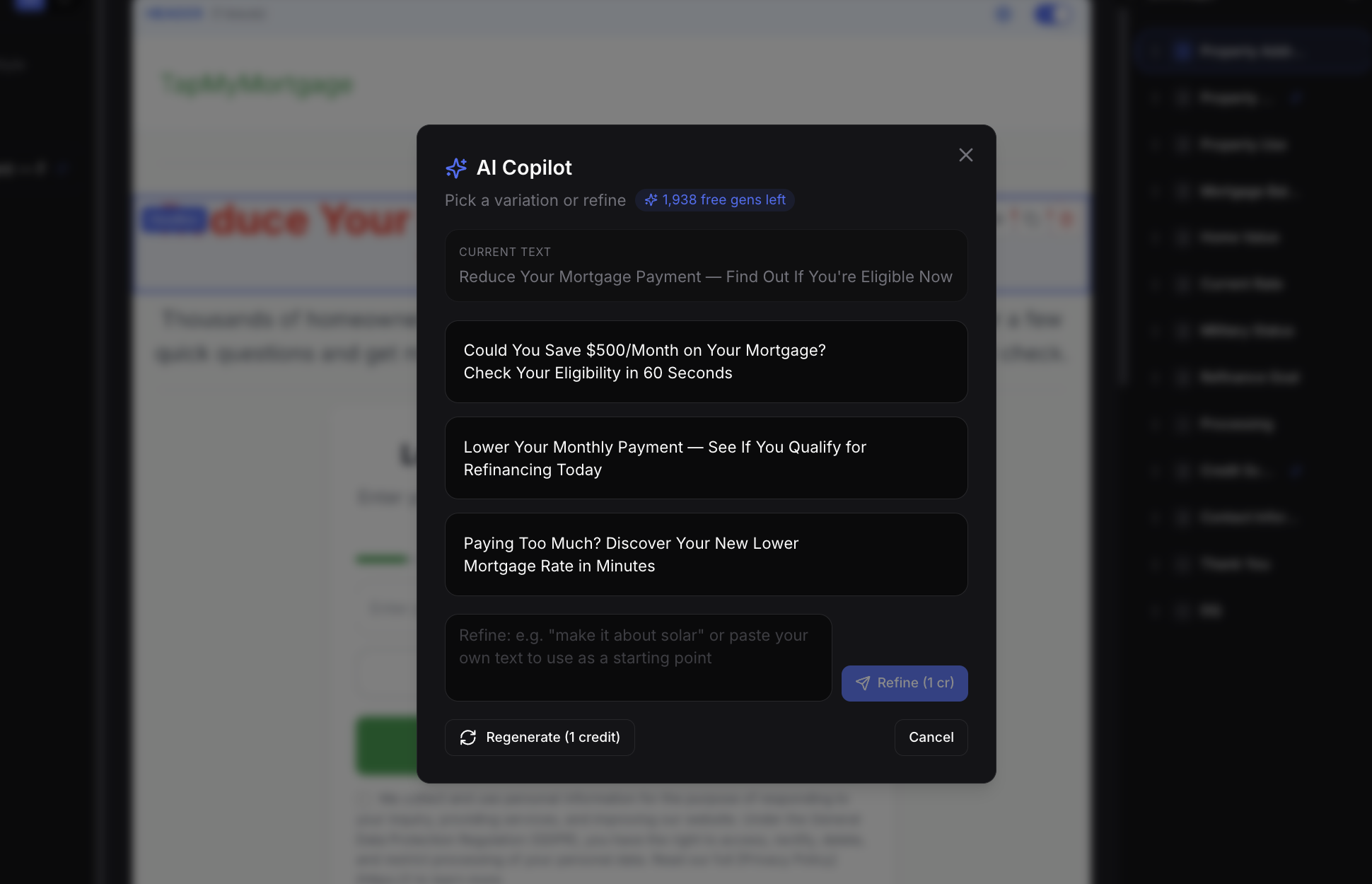
AI Copilot: build and edit faster
Copilot can help you build a funnel from the ground up based on a prompt. You can choose whether you want just the quiz or the full landing page plus form.
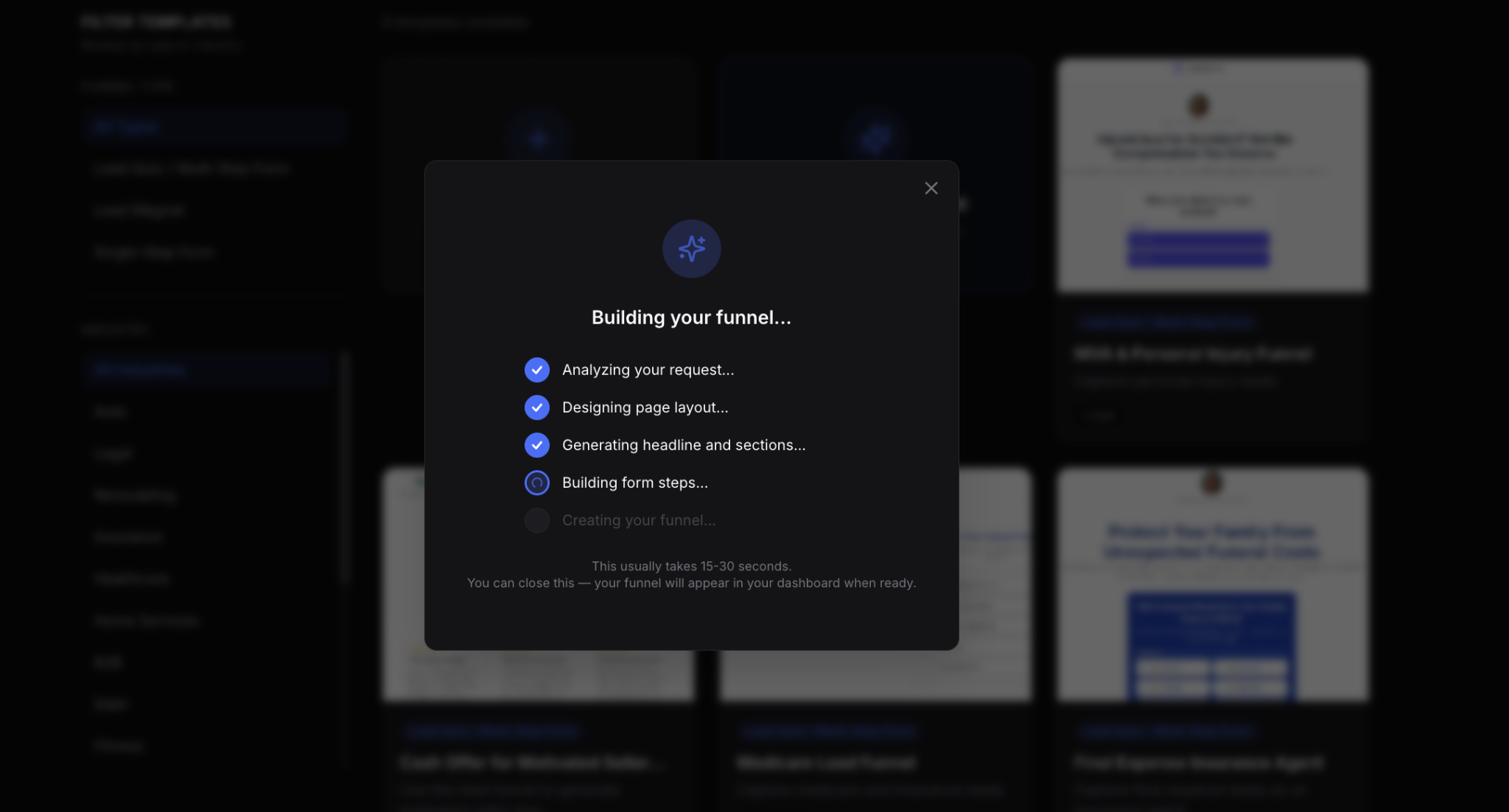
It can also help you edit as you go. If you want to remove icons from options, change step copy, adjust components, set up routing rules, it can handle a lot of that quickly without you clicking into every tiny setting.
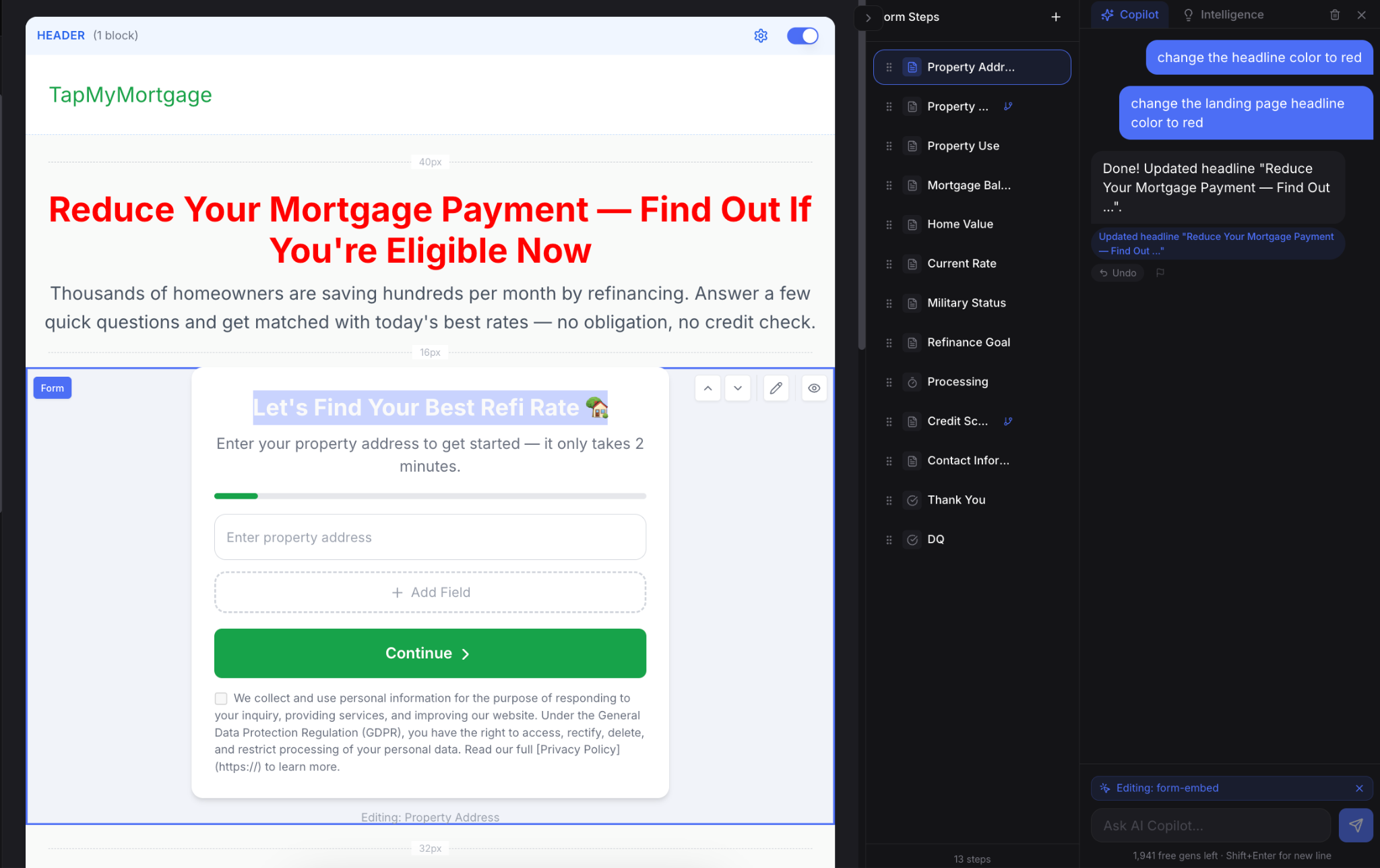
The reason this is powerful is that funnel building has always been a thousand little tasks. Copilot compresses that time.
AI copy assistance: reduce the copy bottleneck
Copy is one of the biggest bottlenecks in building funnels.
Next Gen includes AI-powered copy suggestions directly inside the builder so you can generate headline variations, CTA ideas, and step-level copy improvements without leaving your workflow.
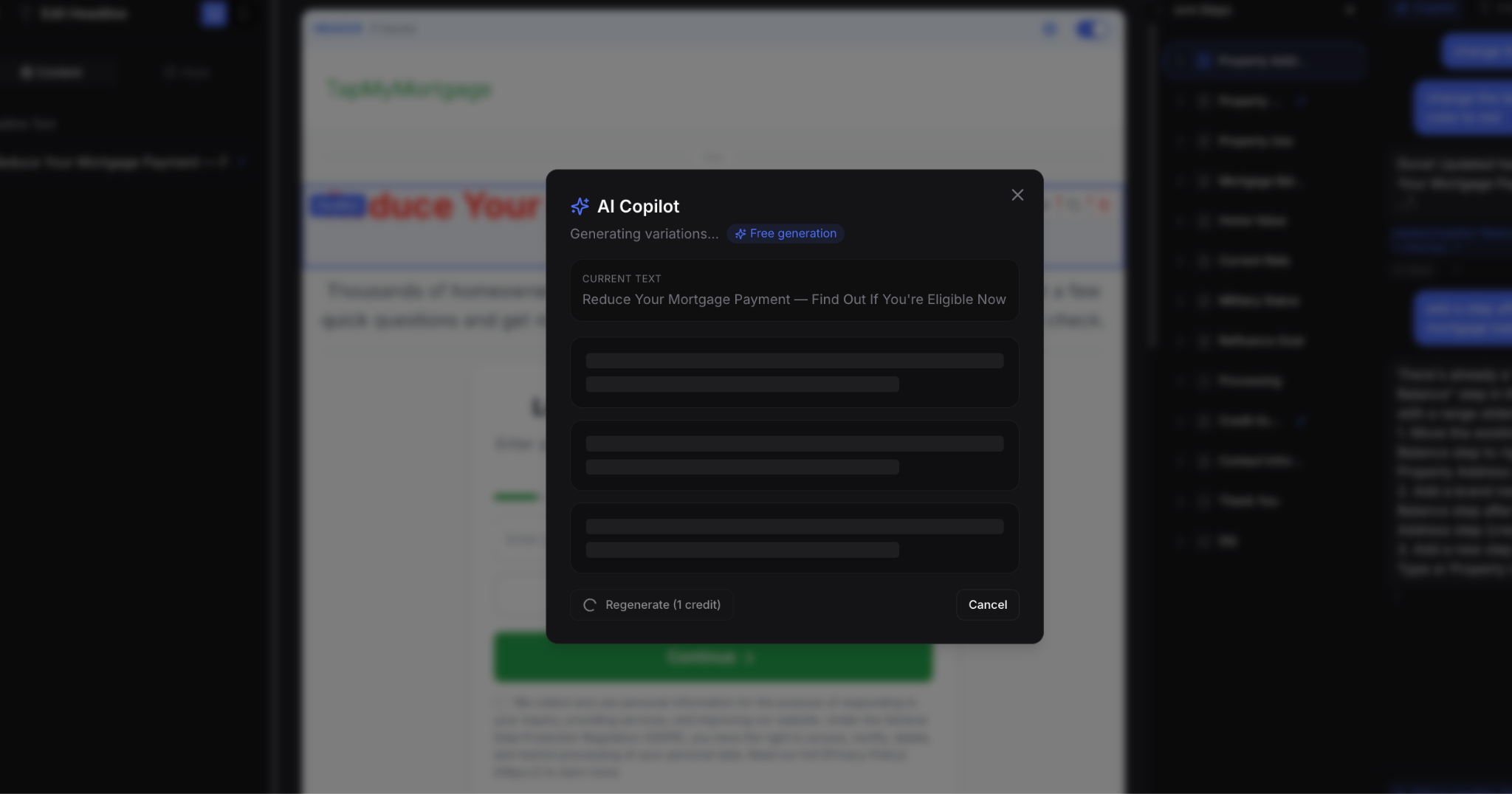
Even if you're a good writer, it's hard to write great conversion copy while you're also thinking about flow, fields, routing, and delivery. This makes it easier to iterate.
AI Intelligence: optimize without living in reports
This is the part I'm most excited about long-term.
Most people do not optimize funnels because they don't have time to dig into reports, interpret step-level drop-offs, and figure out what to change.
AI Intelligence is designed to flip that dynamic.
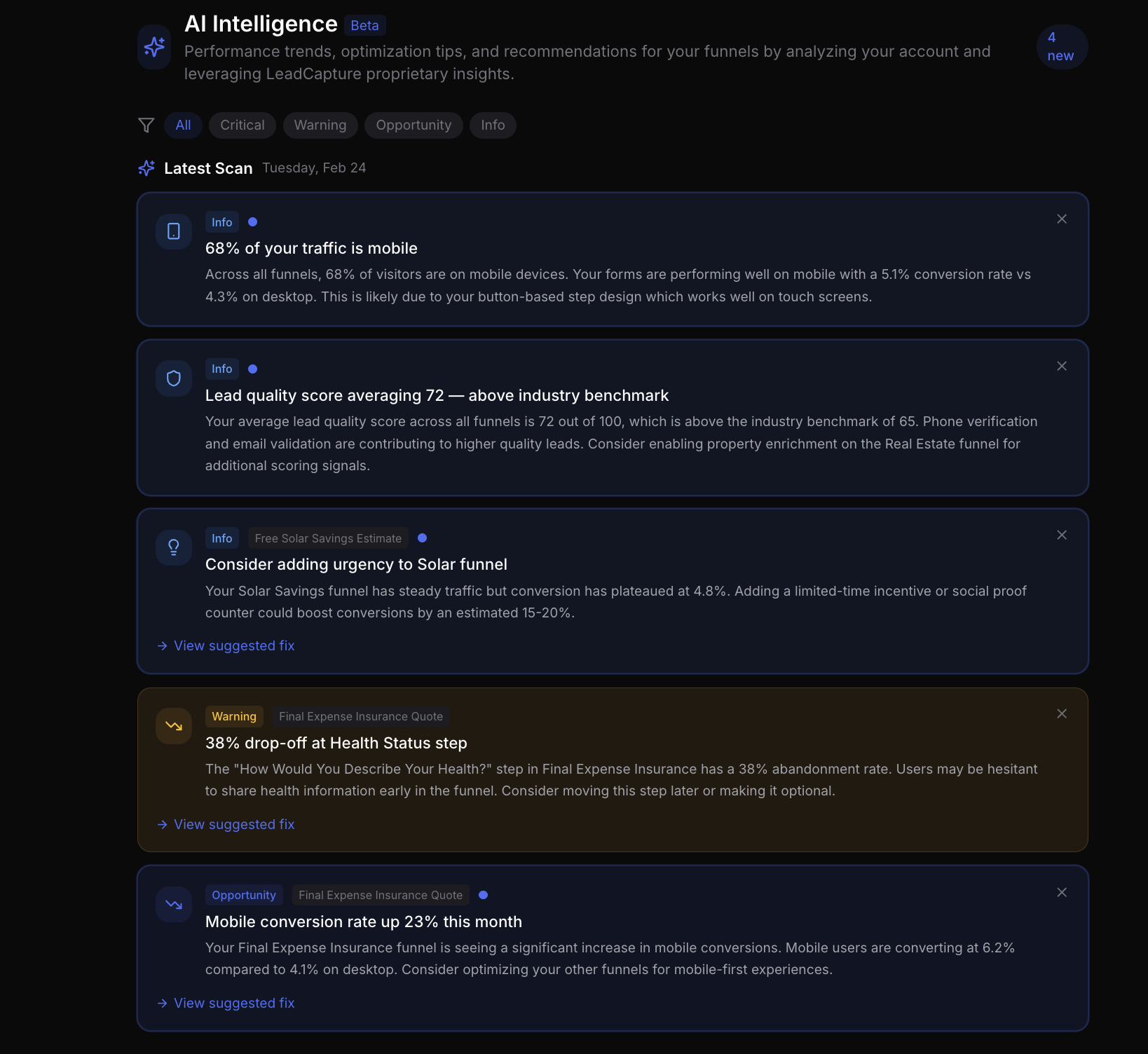
It scans your account and surfaces proactive insights daily or weekly. It flags critical issues, warnings, and opportunities. It can point out where drop-off increased, which steps might be causing friction, and where you should focus first.
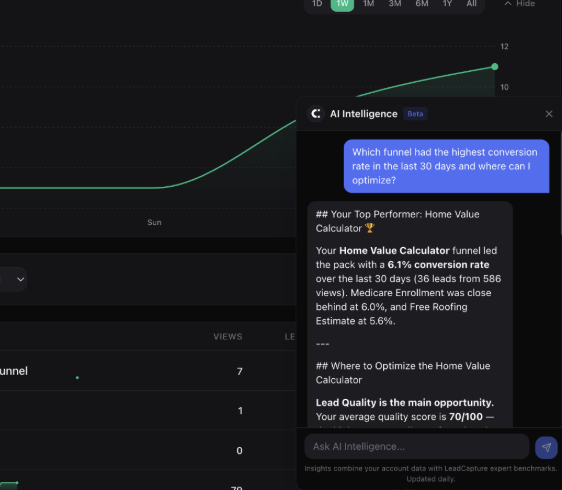
It also lets you ask questions about your performance like "What were my top funnels this week?" and get clear answers without manually pulling reports.
The goal is simple. You should not need to be a full-time analyst to improve conversion rate.
Lead delivery and publishing are designed to be flexible
Next Gen keeps the core promise LeadCapture has always had.
You can route leads wherever they need to go.
You can set up webhook delivery. Use Zapier. Configure email notifications. Connect integrations. Push to your CRM or lead distribution tool. Track delivery logs per lead.
Publishing is also flexible.
The preview link can be live. You can connect a custom domain. You can embed it on an existing page. You can set SEO metadata if you want a funnel to have the ability to rank.
Again, the theme is choice. Next Gen supports the modern "unified funnel on a domain" approach, but it also respects that many teams already have existing landing pages and workflows.
Why we did this, and what it means going forward
I want to end with something that's easy to miss.
I did not build Next Gen as a money grab.
I did not build Next Gen to force anyone to upgrade.
I built Next Gen because it is the platform I've wanted LeadCapture to be for a long time. And based on years of feedback, it is the platform our users have been asking us to build, even if they didn't always describe it in these exact words.
Building it was hard. It was one of the hardest periods of my life.
But the reward for me wasn't just shipping a product. It was the growth, the learning, and the feeling of finally building a foundation that matches the world we're stepping into.
I'm not building this because I'm chasing short-term profit.
I'm building it because I want to build something great, and because I genuinely believe LeadCapture can help people capture better leads, operate faster, and build smarter systems without unnecessary complexity.
That intention is baked into Next Gen.
The vision: building for the next decade in an AI-native world
We are entering a world where AI is deeply embedded in everything we do.
Lead generation will change because of it.
Optimization will change. Enrichment will change. Verification and trust will become even more important. Workflows will become more automated. The winners will be the teams who can build fast, learn fast, and improve fast.
LeadCapture Next Gen is built for that.
Classic is staying and will remain supported.
Next Gen is where we're going.
And we're just getting started.
- John
Some helpful links:
- Sign up for Next Gen
- Sign in to Next Gen (existing customers should use the same email that's on their LeadCapture Classic account)
- Watch our onboarding video
- Existing customer? Here's our migration video
Ready to capture more leads?
Build and optimize high-converting lead funnels, quizzes, and forms with AI-powered lead capture software.
Start Free Trial